Fraud protection.
Now it’s personal.
ANZ Falcon® technology monitors millions of transactions every day to help keep you safe from fraud.
Falcon® is a registered trademark of Fair Isaac Corporation.


Fraud protection.
Now it’s personal.
ANZ Falcon® technology monitors millions of transactions every day to help keep you safe from fraud.
Falcon® is a registered trademark of Fair Isaac Corporation.

Fraud protection.
Now it’s personal.
ANZ Falcon® technology monitors millions of transactions every day to help keep you safe from fraud.
Falcon® is a registered trademark of Fair Isaac Corporation.
ANZ respects human rights, including the rights of our employees, our customers and the people in our communities.

We expect the same respect for human rights from everyone who works for or with us. Our Human Rights Statement (Statement) outlines our approach and is guided by our Code of Conduct and our values, and is informed by internationally recognised human rights frameworks and standards including the United Nations Guiding Principles on Business and Human Rights (UNGPs).

We use risk-based due diligence in seeking to identify risks and impacts associated with our business relationships. You can read more in our Human Rights Statement or our approach to responsible business lending.

We seek to support an open civic space by engaging in dialogue with a cross-section of civil society, allowing diverse views to be shared. Learn more about the way we engage our stakeholders.

We report publicly on our approach to human rights, including in our Annual Report, Modern Slavery and Human Trafficking Statement, Human Rights Grievance Mechanism and Equator Principles reporting.
Our Human Rights Grievance Mechanism (Mechanism) enables people who believe their human rights have been impacted by an ANZ large business lending customer to raise a grievance with ANZ.
In establishing this Mechanism, ANZ aims to provide a framework within which:
> people in any country who consider their human rights have been impacted by an ANZ large business lending customer (affected people) can raise their concerns with ANZ;
> efforts can be made to resolve grievances about alleged adverse human rights impacts associated with large business lending customers, including through dialogue; and
> feedback and recommendations can be provided to ANZ in relation to its policies and processes.
Read more in the Mechanism’s Framework: ANZ Grievance Mechanism Framework June 2025 (PDF 735kB). This Framework applies to grievances submitted after 5 June 2025.
In support of the UNGPs, we periodically assess and prioritise our salient human rights issues, being the areas where we could potentially cause or contribute to the most significant negative impacts on people. This assessment reflects management judgement and may change over time.
Our salient human rights issues are expressed as broad topics
While ANZ may not be able to control or avoid every negative impact related to these issues, we seek to reduce the likelihood of negative human rights impacts arising and, if they do occur, to respond appropriately in the circumstances.
ANZ takes a Group-wide approach to managing modern slavery risks in our operations and supply chain.
We work to build the awareness of employees through targeted training and our suppliers and customers through engagement. We seek to continually improve our policies, processes and due diligence activities that aim to identify, assess and manage modern slavery risk.
You can find our latest and historical Modern Slavery and Human Trafficking Statements on our ESG reporting page.
This Statement has been registered with the UK Home Office (published) and the Australian Attorney General’s Department (under review and has not been officially published on the Register).

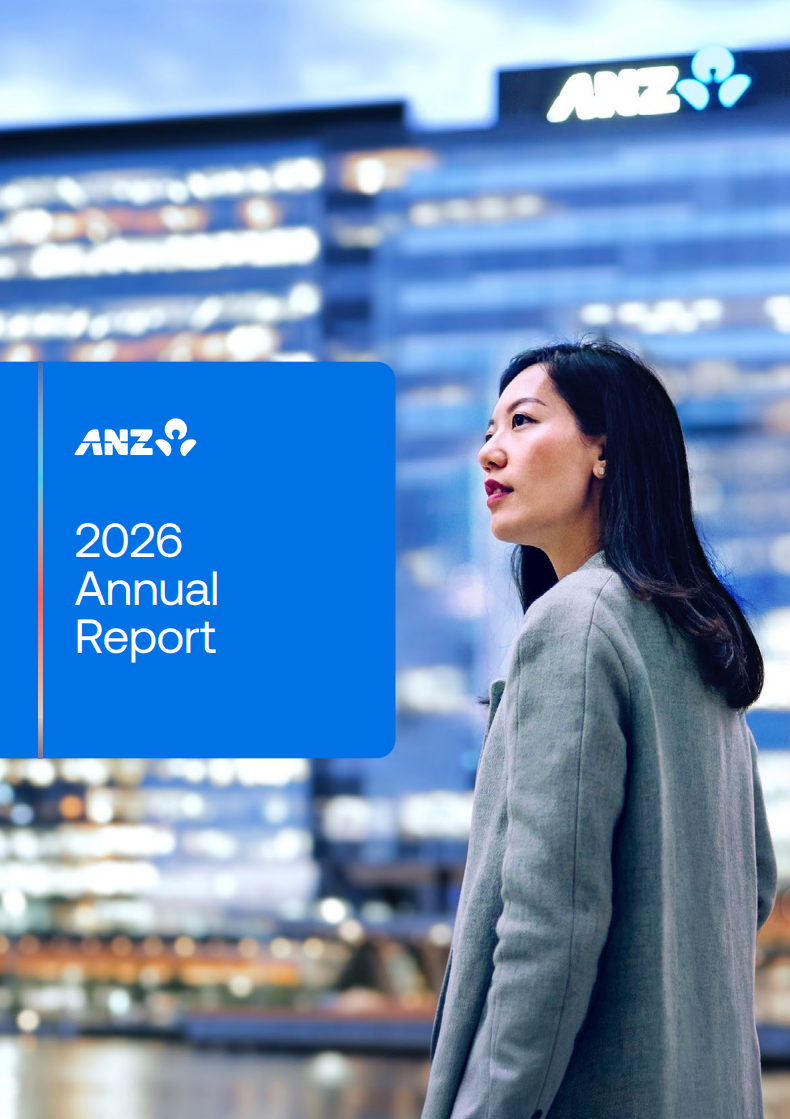
The Annual Report descibes how we are aiming to create value for our stakeholders. This year, ANZ has integrated sustainability disclosures and mandatory climate disclosures into the Annual Report. Released 9 November 2026.
The Annual Report descibes how we are aiming to create value for our stakeholders. This year, ANZ has integrated sustainability disclosures and mandatory climate disclosures into the Annual Report. Released 9 November 2026.
Our Modern Slavery and Human Trafficking Statement covers the actions we have taken to identify, assess and manage modern slavery risks in our operations and supply chain during the 2025 financial year. Released March 2026. This Statement has been registered with the UK Home Office and the Australian Attorney General’s Department.
2026 ANZ Data and Frameworks Pack
Our 2026 Data and Frameworks Pack includes key metrics and comparative performance data, and reporting informed in part by the Global Reporting Initiative. Released 9 November 2026.
1. Clause 15 in ANZ's Human Rights Grievance Mechanism Framework outlines the eligibility requirements for a grievance to be considered for acceptance into the Mechanism.
2. Clause 18-20 in ANZ's Human Rights Grievance Mechanism Framework outlines the requirements for a grievance to be formally accepted into the Mechanism